Quantifying Fish Habitat Enhancement of Living Shorelines: A Case Study in Pensacola Bay
Understanding and Managing Living Resources09:20 AM - 09:35 AM (America/Chicago) 2024/11/19 15:20:00 UTC - 2024/11/19 15:35:00 UTC
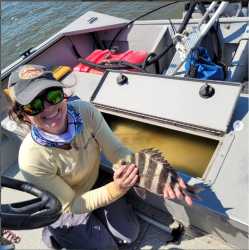
Living shorelines provide many benefits over traditional hard armoring. One of the most widely stated but least tested benefits is the enhancement of habitats for fisheries species. This project uses the highly visible public restorations of Project GreenShores I & II in Pensacola as demonstration sites to quantify the fish habitat benefits of these projects. During Fall 2023 and Spring 2024, underwater video surveys were used to compare fish communities across the restored seascapes, adjacent bare substrates, and hardened shorelines to quantify how many more fish are present due to the habitat restoration and which habitats they prefer. From a total of 414 replicate 10-minute videos, we found that breakwaters, oyster reefs, and marsh habitats created during restoration all house more diverse and abundant fish communities than bare areas and adjacent control sites. Important fisheries species including white and striped mullet, mangrove snapper, and sheepshead, were common across restored habitats. For example, in Fall 2023, mullet and mangrove snapper were present in over 80% of videos on the offshore edge of breakwaters, and sheepshead were present in over half of these videos. Complete analysis of the videos will provide quantitative data on the distribution and density of each species among the various restored habitats, allowing us to determine how many more fish are present in the area due to restoration. Demonstrating habitat enhancement values of highly visible public restoration projects will help guide future restoration projects to maximize valuable fish habitat, foster a greater appreciation of living shoreline approaches, and encourage their broader support and uptake in the community.
Habitat Selection and Behavior of Sportfish Around Shoreline Protection Structures
Understanding and Managing Living Resources09:35 AM - 09:50 AM (America/Chicago) 2024/11/19 15:35:00 UTC - 2024/11/19 15:50:00 UTC
We used fine-scale acoustic telemetry to monitor the habitat selection and behavior of Red Drum Sciaenops ocellatus, Speckled Trout Cynoscion nebulosus, and Sheepshead Archosargus probatocephalus throughout a restored seascape off the coast of Bayou la Batre, Alabama. Within the span of three km are five different types of shoreline protection structures installed as part of several shoreline restoration projects: Lightning Point Marsh is protected by riprap breakwaters; Little Bay Peninsula is protected by large concrete wave attenuation pyramids with a single segment of miniature pyramids; Point aux Pins Peninsula is also protected by large breakwater pyramids, which were installed after manmade oyster reefs became largely eroded. Because all these breakwater structures occur within the home range of individual fish, we have the opportunity to evaluate fish preferences and behavioral responses to these various shoreline protection strategies.
Acoustic receivers placed with overlapping detection radii triangulated the precise locations of tagged fish with an accuracy of 1-2 m, so we were able to observe how fishes used these protected shorelines with microhabitat-level specificity. We could also infer fish behavior from the triangulated positions. By calculating the step-length and turning angle between successive positions, we determined if fish were: (1) sheltering / laying in wait to ambush, a behavior made up of very short steps and minimal turns; (2) foraging, a behavior made up of tortuous paths of medium-length steps; or (3) travelling between habitats, a behavior indicated by straight paths of longer steps. This detailed understanding of how sportfish interact with different types of shoreline protection structures can be used to inform future shoreline restoration initiatives. Resource managers and stakeholders can potentially select a structure that both mitigates shoreline erosion and provides the greatest habitat enhancement for recreationally important species.
Presenters Sarah Ramsden University Of South Alabama Stokes School Of Marine & Environmental Sciences At Dauphin Island Sea Lab Co-Authors
Ronald Baker University Of South Alabama, Dauphin Island Sea Lab
Near-Surface Dynamic Structures of the Gulf of Mexico Basin and their Importance in Delineating Spawning Area of Atlantic Bluefin Tuna
Understanding and Managing Living Resources09:50 AM - 10:05 AM (America/Chicago) 2024/11/19 15:50:00 UTC - 2024/11/19 16:05:00 UTC
Atlantic Bluefin Tuna, Thunnus thynnus (ABFT), spawn in the Mediterranean Sea, the Slope Sea of the NW Atlantic and the Gulf of Mexico (GOM). These areas have commonalities, including a highly dynamic environment which draws nutrient input from adjacent shelf areas and offers a modest degree of protection during the vulnerable egg to flexion (~ 9 days) larval stages of ABFT. Choice of specific spawning areas to avoid major invertebrate predators (jellyfish) can play a strong role in reducing mortality of bluefin tuna offspring during the early developmental stages. Focusing on the GOM, the intruding Loop Current and its eddy field create a highly structured environment, principally independent of the local wind field. These structures evolve continuously as the eddies decay in their progress to the western GOM, hypothetically sweeping pelagic jellyfish into temporal patches and lines and leaving some areas with reduced predation. Both the adults and larvae (ephyrae) of Pelagia noctiluca and adults of other epipelagic jellyfish are known predators of ABFT eggs and larvae and when present in high concentrations can deplete an area of ABFT eggs and preflexion larvae. In this study, archived Hycom modeled currents were used to estimate the spatial and temporal extent of the structured environment in relation to life histories of both ABFT and jellyfish. We propose that the dynamics of the GOM produce an environment that is suitable for nutrient supply as well as provide some degree of protection from predators during ABFT early development.
Jim Franks University Of Southern Mississippi, Gulf Coast Research Lab's Fisheries Center
Gulf Sturgeon (Acipenser desotoi) Spawning Related Movements in the Bouie River system
Understanding and Managing Living Resources10:05 AM - 10:20 AM (America/Chicago) 2024/11/19 16:05:00 UTC - 2024/11/19 16:20:00 UTC
Gulf Sturgeon (Acipenser desotoi) are a federally threatened anadromous fish that inhabits the Northern Gulf of Mexico and currently has seven known natal rivers from LA to FL. Fidelity to their natal rivers is high, with populations east and west of Mobile Bay, AL being genetically similar, despite not being managed as distinct population units. The Pascagoula River Gulf Sturgeon population recovery rate has been slower than their Eastern counterparts. Significant data gaps exist regarding the Pascagoula River population spawning movements, with only one documented spawning site identified in the Bouie River. As such, it is essential to understand the Pascagoula population's timing and duration of Gulf Sturgeon use of the Bouie River to propel recovery efforts. Our study analyzed the spawning-associated movement of Gulf Sturgeon, the response to changing river discharge, and the potential use of unique anthropogenic formations in the Bouie River through the use of acoustic telemetry data. The results revealed distinct spawning movements each spring, with fish entering the Bouie River in early March. Movement patterns were further delineated by associating sex with an individual's behavior. Sex delineation was based on the recurrence of an individual over the 4-year time frame and the length of residency in the Bouie. Behavioral patterns revealed a sex ratio of 1.57: 1 male to female. Detection densities were correlated with USGS stream flow data, revealing upstream-spawning movement during high discharge events. We found Gulf Sturgeon are capable of crossing a low-head damn on the Bouie River, and had varying rates of occupancy in the aggregate mined pits of the lower Bouie River; this includes 3 individuals that remained in this reach until fall. The results of this study demonstrate the increasing need to protect Mississippi waterways that are vital to the conservation of Gulf Sturgeon species.
 Alex Rodriguez
 Sarah Ramsden